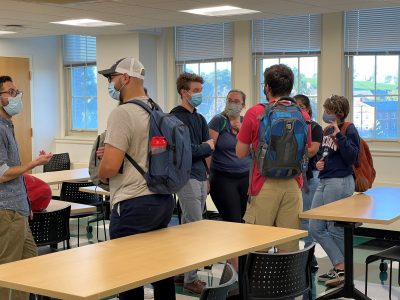
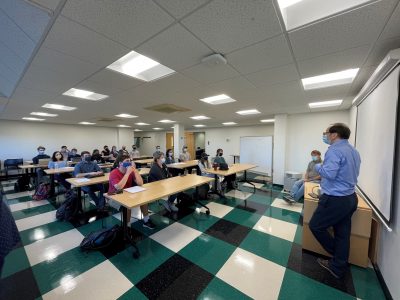
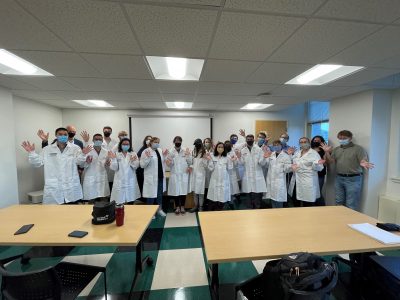
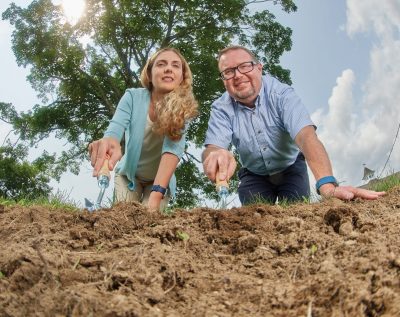
UConn Today recently published a story highlighting professors Patricia Rossi and Spencer Nyholm and their course, MCB 2612: Microbe Hunters.
Web cookies (also called HTTP cookies, browser cookies, or simply cookies) are small pieces of data that websites store on your device (computer, phone, etc.) through your web browser. They are used to remember information about you and your interactions with the site.
Session Management:
Keeping you logged in
Remembering items in a shopping cart
Saving language or theme preferences
Personalization:
Tailoring content or ads based on your previous activity
Tracking & Analytics:
Monitoring browsing behavior for analytics or marketing purposes
Session Cookies:
Temporary; deleted when you close your browser
Used for things like keeping you logged in during a single session
Persistent Cookies:
Stored on your device until they expire or are manually deleted
Used for remembering login credentials, settings, etc.
First-Party Cookies:
Set by the website you're visiting directly
Third-Party Cookies:
Set by other domains (usually advertisers) embedded in the website
Commonly used for tracking across multiple sites
Authentication cookies are a special type of web cookie used to identify and verify a user after they log in to a website or web application.
Once you log in to a site, the server creates an authentication cookie and sends it to your browser. This cookie:
Proves to the website that you're logged in
Prevents you from having to log in again on every page you visit
Can persist across sessions if you select "Remember me"
Typically, it contains:
A unique session ID (not your actual password)
Optional metadata (e.g., expiration time, security flags)
Analytics cookies are cookies used to collect data about how visitors interact with a website. Their primary purpose is to help website owners understand and improve user experience by analyzing things like:
How users navigate the site
Which pages are most/least visited
How long users stay on each page
What device, browser, or location the user is from
Some examples of data analytics cookies may collect:
Page views and time spent on pages
Click paths (how users move from page to page)
Bounce rate (users who leave without interacting)
User demographics (location, language, device)
Referring websites (how users arrived at the site)
Here’s how you can disable cookies in common browsers:
Open Chrome and click the three vertical dots in the top-right corner.
Go to Settings > Privacy and security > Cookies and other site data.
Choose your preferred option:
Block all cookies (not recommended, can break most websites).
Block third-party cookies (can block ads and tracking cookies).
Open Firefox and click the three horizontal lines in the top-right corner.
Go to Settings > Privacy & Security.
Under the Enhanced Tracking Protection section, choose Strict to block most cookies or Custom to manually choose which cookies to block.
Open Safari and click Safari in the top-left corner of the screen.
Go to Preferences > Privacy.
Check Block all cookies to stop all cookies, or select options to block third-party cookies.
Open Edge and click the three horizontal dots in the top-right corner.
Go to Settings > Privacy, search, and services > Cookies and site permissions.
Select your cookie settings from there, including blocking all cookies or blocking third-party cookies.
For Safari on iOS: Go to Settings > Safari > Privacy & Security > Block All Cookies.
For Chrome on Android: Open the app, tap the three dots, go to Settings > Privacy and security > Cookies.
Disabling cookies can make your online experience more difficult. Some websites may not load properly, or you may be logged out frequently. Also, certain features may not work as expected.
October 15, 2021
UConn Today recently published a story highlighting professors Patricia Rossi and Spencer Nyholm and their course, MCB 2612: Microbe Hunters.

September 13, 2021
August 30, 2021
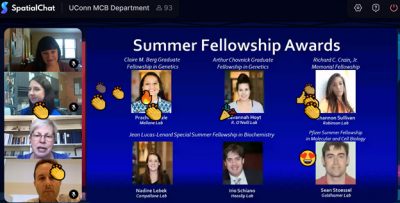
MCB held a Departmental Retreat on Thursday, August 26th. After welcoming remarks, the 2021 MCB graduate awards were announced.
Following a ‘Get to Know the New Students’ event, new faculty member, Assistant Professor, Jelena Erceg presented a talk, “Genome Folding and Regulation in Diploid Multicellular Organisms”
A fun trivia session preceded the Lab Poster Sessions. The virtual event was held on a fun, new platform called SpacialChat that split the presentations into 5 different poster rooms allowing attendees to circulate among the rooms. The retreat finished with a Social Mixer with Happy hour rooms. Screen shots of the event can be found here.
August 29, 2021
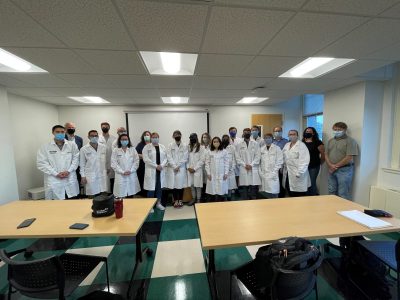
The Fall MCB PSM/PM Orientation event was held Thursday, 9/2. The event was held in-person and the students seemed enthusiastic, energetic and appreciative of the face to face companionship.

New students attend in-person orientation

Students really appreciated an in-person event, chatting long after the event was scheduled to end.

PSM Orientation included Spring, Summer, Fall 2021 as well as a few who entered in 2020

August 4, 2021
Teschke will spend four months at the University of York studying the geometry and evolution of a type of virus that could help develop antivirals. Story in UConn Today, Amanda Song, CLAS
Carolyn Teschke, professor and department head of molecular and cell biology at UConn, has been awarded a Fulbright Scholar Award to study virus assembly and evolution at the University of York, in the United Kingdom.
Teschke applied for the scholarship after talking with colleagues at the University of York for months about a collaborative project working on the process of virus assembly. The Fulbright, which is awarded by the U.S. State Department and international sponsors, will allow her to conduct research in the U.K. for four months.
“I am so pleased and excited to receive this prestigious award to study in the U.K.,” says Teschke. “My hosts at the University of York, Professors Riedun Twarock, a mathematician who studies virus architecture, and Fred Antson, who studies large bacteriophages, will work with me to mathematically model how viruses assemble using experimental data generated in my lab.”
Teschke’s research focuses on understanding how a virus puts itself together inside an infected cell. Using a model system of bacteriophage P22, a well-known type of virus that infects bacteria, Teschke’s lab group models how a herpes virus would attack, assemble, and replicate inside a human cell.
“Rather than studying a herpes virus, growing cell cultures and risking getting infected, we use this simple model system,” Teschke says. “If we understand how our model system works, hopefully that information will assist scientists that study herpes viruses and help them develop antivirals.”
An antiviral for the herpes virus might prevent it from replicating once it attacks a cell, thus reducing the chances of someone getting sick.
Teschke hopes to use her lab’s data and Twarock’s mathematics expertise in the geometry of virus capsids, or its outer protein-based shell, to understand on a more detailed level how the different proteins of P22 assemble.
“It’s almost like a dance, the way the virus proteins have to come together in a specific order, with a particular affinity, or tightness, to make the capsid,” Teschke says. “If we have an idea how tight the interaction between the proteins must be, we can make an antiviral that interrupts that process in the early stages.”
By collaborating with Antson, Teschke hopes to understand how a virus evolves to grow bigger over time, and whether she can change the proteins in her model virus to become bigger, like the ones Antson works with. This would help her understand the process of virus evolution, where a virus accumulates mutations that affect the viral capsid geometry.
July 27, 2021
The Graduate School offers a Conference Participation Award (previously known as the Doctoral Student Travel Award) to support students’ ability to present their research at national or international meetings and conferences, including both in-person and virtual events. Jeffrey Tamucci, Didem Ozcan, and Nidhi Vijayan each received an award that will be used for participation in a conference at which the student is presenting their research.
July 22, 2021
Summer Undergraduate Researcher Paul Isaac '23 works to find a synthetic protein to help an ancient species. UConn’s Office of Undergraduate Research each year provides Summer Undergraduate Research Fund (SURF) awards to support full-time undergraduate students in summer research or creative projects. Paul Isaac, a rising Junior majoring in Molecular and Cell Biology and diagnostic and genetic science is doing research on the genomic and cellular components of the horseshoe crab and their immune response with faculty mentor Rachel O’Neill, a professor in the Department of Molecular and Cell Biology.
Learn more in UConn Today
June 9, 2021

Aoife Heaslip has received a grant to study the molecular underpinnings of a parasite that can cause severe infections in people who are immunocompromised and babies.
Toxoplasmosis is a common but usually non-life-threatening parasitic infection linked to contaminated food or water. While most people infected by Toxoplasma gondii (T. gondii), the parasite responsible for toxoplasmosis, will have very mild or no symptoms at all, the parasite can persist in the body for long periods of time, possibly even an entire lifetime.
People who are immunocompromised and babies, if infection occurs in utero, can suffer severe symptoms. If a person’s immune system cannot combat the infection, it may cause damage to the brain, eyes, or other organs. T. gondii is a leading cause of congenital neurological defects.
University of Connecticut assistant professor of molecular and cell biology Aoife Heaslip has received a $2 million grant from the National Institute of General Medical Sciences to study molecular functions of T. gondii. Heaslip hopes this work will provide a better understanding of how this parasite operates and thus pave the way for new therapeutic approaches.
Heaslip will focus on T. gondii’s intracellular cargo transport mechanism. This process involves the movement of vesicles — cellular transport containers for materials like proteins — within a cell. Intracellular transport and vesicle secretion are essential cellular functions for all eukaryotes. For T. gondii, they are key to this pathogens ability to invade and grow within its host’s cells.
Despite its importance, to date, scientists have only studied cargo transport mechanisms in a small number of model species leaving wide knowledge gaps about how other eukaryotes, like T. gondii, complete this task.
The goal of Heaslip’s lab is to uncover the cargo transport mechanism in T. gondii. Their previously published data show there are two proteins: actin and unconventional myosin (MyoF), required for intracellular cargo transport in T. gondii. Both proteins are part of the T. gondii’s cytoskeleton, the part of the cell responsible for maintaining cell shape and locomotion.
Heaslip’s lab will utilize an interdisciplinary combination of approaches including parasite genetics and cell biology, live cell imaging and quantitative vesicle tracking, and in-vitro biophysical approaches to answer these questions.
“My laboratory occupies a unique niche at the intersection between parasitology and molecular motors fields,” Heaslip says. “Utilizing these interdisciplinary approaches makes us ideally positioned to provide new insights into this understudied process.”
Heaslip will work to understand how the cells regulate MyoF activity and how cargo packaged in vesicles interact with the actin cytoskeleton. She will also identify if there are additional molecular plays required for cargo transport and how they work with actin and MyoF to accomplish this task.
This work is relevant beyond toxoplasmosis as T. gondii is closely related to parasites that cause malaria and life-threatening diarrheal diseases. Understanding T. gondii’s transport mechanism will also provide insights into these parasites.
By understanding how a parasite like T. gondii completes cargo transport functions, scientists can leverage that knowledge to develop ways to interrupt this process with drugs that would kill the parasite.
Heaslip holds a Ph.D. from the University of Vermont. She completed postdoctoral training at Indiana University, Bloomington and the University of Vermont. Her research focuses on understanding the biology of T. gondii using interdisciplinary methods to elucidate the molecular mechanisms underlying essential processes for this parasite to identify new drug targets.
May 17, 2021
The National Fellowship Incentive Program works to build a stronger student and faculty culture around applying for prestigious, nationally competitive scholarships and fellowships. Under this program, Drs. Eric May, Rachel O'Neill and Victoria Robinson have been recognized for their work mentoring students through the process of developing proposals and submitting applications for eligible awards.
May 4, 2021
MCB is proud to announce that Katelyn Denegre and Nina Wang have been named the 2020-2021 Outstanding MCB TAs in recognition of their outstanding contributions, professional dedication to inspiring student learning and commitment to education.
Please join us in congratulating Katelyn and Nina on their notable accomplishments.