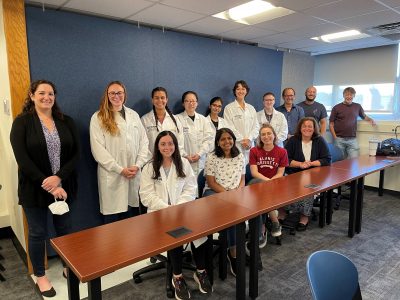
MCB Seminar Series: Dr. Jeremy Rotty
September 21, 2022
Web cookies (also called HTTP cookies, browser cookies, or simply cookies) are small pieces of data that websites store on your device (computer, phone, etc.) through your web browser. They are used to remember information about you and your interactions with the site.
Session Management:
Keeping you logged in
Remembering items in a shopping cart
Saving language or theme preferences
Personalization:
Tailoring content or ads based on your previous activity
Tracking & Analytics:
Monitoring browsing behavior for analytics or marketing purposes
Session Cookies:
Temporary; deleted when you close your browser
Used for things like keeping you logged in during a single session
Persistent Cookies:
Stored on your device until they expire or are manually deleted
Used for remembering login credentials, settings, etc.
First-Party Cookies:
Set by the website you're visiting directly
Third-Party Cookies:
Set by other domains (usually advertisers) embedded in the website
Commonly used for tracking across multiple sites
Authentication cookies are a special type of web cookie used to identify and verify a user after they log in to a website or web application.
Once you log in to a site, the server creates an authentication cookie and sends it to your browser. This cookie:
Proves to the website that you're logged in
Prevents you from having to log in again on every page you visit
Can persist across sessions if you select "Remember me"
Typically, it contains:
A unique session ID (not your actual password)
Optional metadata (e.g., expiration time, security flags)
Analytics cookies are cookies used to collect data about how visitors interact with a website. Their primary purpose is to help website owners understand and improve user experience by analyzing things like:
How users navigate the site
Which pages are most/least visited
How long users stay on each page
What device, browser, or location the user is from
Some examples of data analytics cookies may collect:
Page views and time spent on pages
Click paths (how users move from page to page)
Bounce rate (users who leave without interacting)
User demographics (location, language, device)
Referring websites (how users arrived at the site)
Here’s how you can disable cookies in common browsers:
Open Chrome and click the three vertical dots in the top-right corner.
Go to Settings > Privacy and security > Cookies and other site data.
Choose your preferred option:
Block all cookies (not recommended, can break most websites).
Block third-party cookies (can block ads and tracking cookies).
Open Firefox and click the three horizontal lines in the top-right corner.
Go to Settings > Privacy & Security.
Under the Enhanced Tracking Protection section, choose Strict to block most cookies or Custom to manually choose which cookies to block.
Open Safari and click Safari in the top-left corner of the screen.
Go to Preferences > Privacy.
Check Block all cookies to stop all cookies, or select options to block third-party cookies.
Open Edge and click the three horizontal dots in the top-right corner.
Go to Settings > Privacy, search, and services > Cookies and site permissions.
Select your cookie settings from there, including blocking all cookies or blocking third-party cookies.
For Safari on iOS: Go to Settings > Safari > Privacy & Security > Block All Cookies.
For Chrome on Android: Open the app, tap the three dots, go to Settings > Privacy and security > Cookies.
Disabling cookies can make your online experience more difficult. Some websites may not load properly, or you may be logged out frequently. Also, certain features may not work as expected.
September 21, 2022
Tuesday, September 27th, 2022
3:30 PM - 4:30 PM
BPB 130
Jeremy Rotty, Ph.D.
Assistant Professor of Biochemistry and Molecular Biology
Uniformed Services University
Host: Ken Campellone
September 15, 2022
Jelena Erceg is studying the role of parental genome folding during development which could support the development of personalized genome medicine for chromosome-based diseases.
See full story in UConn Today
September 9, 2022
Dr. Carolyn Teschke has accepted the role of MCB department head and will serve in that position for the next five years. She is joined in the new administrative structure by Dr. Victoria Robinson, who will serve as Associate head for Graduate Research and Education, and Dr. Daniel Gage, who will serve as Associate head for Undergraduate Research and Education.

Dr. Carolyn Teschke, Professor and Department Head

Dr. Victoria Robinson, Associate Professor and Associate Department Head of Graduate Research and Education

Dr. Daniel Gage, Professor and Associate Head of Undergraduate Research and Education
Milligan-McClellan KC, Dundore-Arias JP, Klassen JL, Shade A, Kinkel LL, and Wolfe BE. Deciphering the Microbiome: Integrating Theory, New Technologies, and Inclusive Science. 2022 mSystems https://doi.org/10.1128/msystems.00583-22
Green EA and Klassen JL. Trachymyrmex septentrionalis Ant Microbiome Assembly Is Unique to Individual Colonies and Castes. mSphere 7:00989-21 https://doi.org/10.1128/msphere.00989
September 8, 2022

The MCB Professional Science Master's Program held their Fall Orientation on Thursday, 9/1. The event went well with all students enthusiastic and energetic. Best wishes for a great year!!
August 30, 2022
Michel Giovanni Santiago-Martinez (Geo) has joined the Department of Molecular and Cell Biology as an assistant professor. Santiago-Martinez is a microbiologist from Universidad Nacional Autónoma de México (UNAM) and The Pennsylvania State University. He is interested in the ecophysiology of archaea and anaerobic bacteria, and how energy status influences their ability to resist environmental stress conditions, such as exposure to oxygen and nutritional starvation. His research goal is to understand the function of anaerobic microorganisms in biogeochemical cycles and host-associated microbiomes. He is also interested in bringing up-to-date knowledge of archaea to the classrooms and outreach activities, as well as promoting more inclusive science through mentoring activities and service initiatives.
August 23, 2022
Nathan Alder contributed to a collaborative study led by a group from the UConn School of Nursing that was just published in Developmental Neurobiology. The title is "Associations of Mitochondrial Function, Stress, and Neurodevelopmental Outcomes in Early Life: A Systematic Review"
August 22, 2022

A big welcome to our new grad students!
Please join us for our first MCB Seminar of the semester!
Tuesday, August 30th, 2022
3:30 PM - 4:30 PM
BPB 130
Dr. Lawrence David, Associate Professor, Molecular Genetics & Microbiology, Duke University
Host: Kat Milligan-McClellan
"Nutrient limitation and the gut microbiome"
Summary: How does diet shape gut microbial ecology across mammals?
Bio: Dr. Lawrence David is an associate professor in Duke University’s Department of Molecular Genetics and Microbiology and Interim Director of the Duke Microbiome Center. The David Lab studies relationships between diet, the gut microbiome and human health. The lab is also interested in engineering new tools at the interface of nutrition and microbiology, including building genomic approaches for tracking food intake and microfluidic techniques for high-throughput assay of microbial metabolism. Lawrence was a Junior Fellow at the Harvard Society of Fellows, and he received a Ph.D. in Computational & Systems Biology from the Massachusetts Institute of Technology and a B.S. in Biomedical Engineering from Columbia University. Lawrence has been named one of the 10 Scientists under 40 years old to watch by ScienceNews and his work has been recognized with innovator and investigator awards from the Burroughs Wellcome Fund, the Searle Scholars Program, and the Arnold & Mabel Beckman, Hartwell, Alfred P. Sloan, and Damon Runyon Foundations.
To learn more about Dr. David and his work, view his publication https://www.nature.com/articles/s41564-018-0267-7 and visit his website at http://www.ladlab.org
Join us at 3:15 in the BPB lobby for refreshments, Seminar begins at 3:30
Livestream here: https://www.kaltura.com/index.php/extwidget/preview/partner_id/2090521/uiconf_id/38934061/entry_id/1_904uedgo/embed/dynamic?
August 16, 2022
Assistant Professor Jelena Erceg (Department of Molecular and Cell Biology, CLAS & Institute for Systems Genomics, joint appointment also with the Department of Genetics and Genome Sciences, UConn Health) has received a prestigious R35 Maximizing Investigator’s Research Award (MIRA) for Early Stage Investigators from the National Institute of Health (NIH) and National Institute of General Medical Sciences (NIGMS). This award will support research in the Erceg Lab on genome folding and regulation over the next 5 years.
The title of the funded project is “Genome Folding and Regulation in Diploid Multicellular Organisms”
About the research and why it is important
MIRA provides support for the research in an investigator's laboratory that falls within the mission of NIGMS. The goal of MIRA is to increase the efficiency of NIGMS funding by providing investigators with greater stability and flexibility, thereby enhancing scientific productivity and the chances for important breakthroughs. The program will also help distribute funding more widely among the nation's highly talented and promising investigators.