About the Cell and Developmental Biology Program
The Cell and Developmental Biology (CDB) Program at the University of Connecticut provides broad training in fundamental areas of cell biology, embryonic development, and regenerative biology, and students may pursue research leading to a Master's or Ph.D. degree. Students interested in careers in the biotechnology and pharmaceutical industries may also pursue an MS degree in Applied Biochemistry and Cell Biology in the Professional Master’s Program.
Research Focus
Areas of research focus include investigations at the fundamental, applied, and translational levels of cell and developmental biology. Consequently, our research programs are multidisciplinary in nature and incorporate extensions into all of the other areas of interest in MCB. Research topics include regulation and biomechanics of cell motility, cytoskeletal dynamics, cell stress responses, host-pathogen interactions, transcriptional mechanisms that regulate development and regeneration, immune cell signaling and discovery of immunomodulatory small molecules, stem cell biology, and animal models of disease.
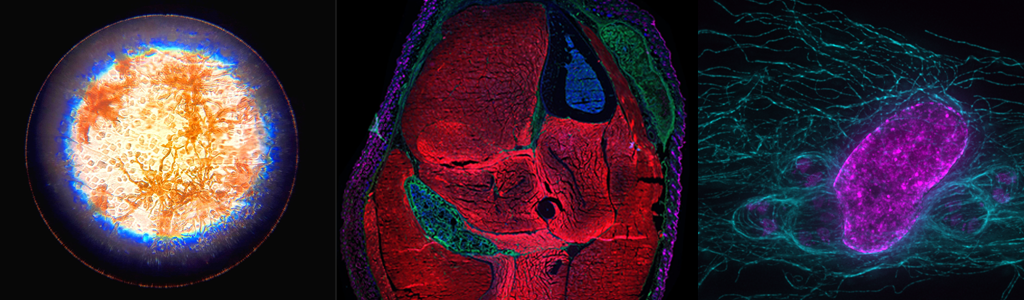 (Left) Image of a pigment cell on a fish scale viewed with transmitted light using a 100-year-old UConn microscope (Juliet Lee) (Center) A cross-section of the lower hind limb of an adult mouse with a genetic mutation that causes Fibro/Adipogenic progenitor (FAP) cells to form cartilage and bone (Russ Hanson) (Right) Host cell microtubules (cyan) forming cages around Toxoplasma gondii parasites (small magenta structures), with host cell nucleus (large magenta structure) (Michael Griffith)